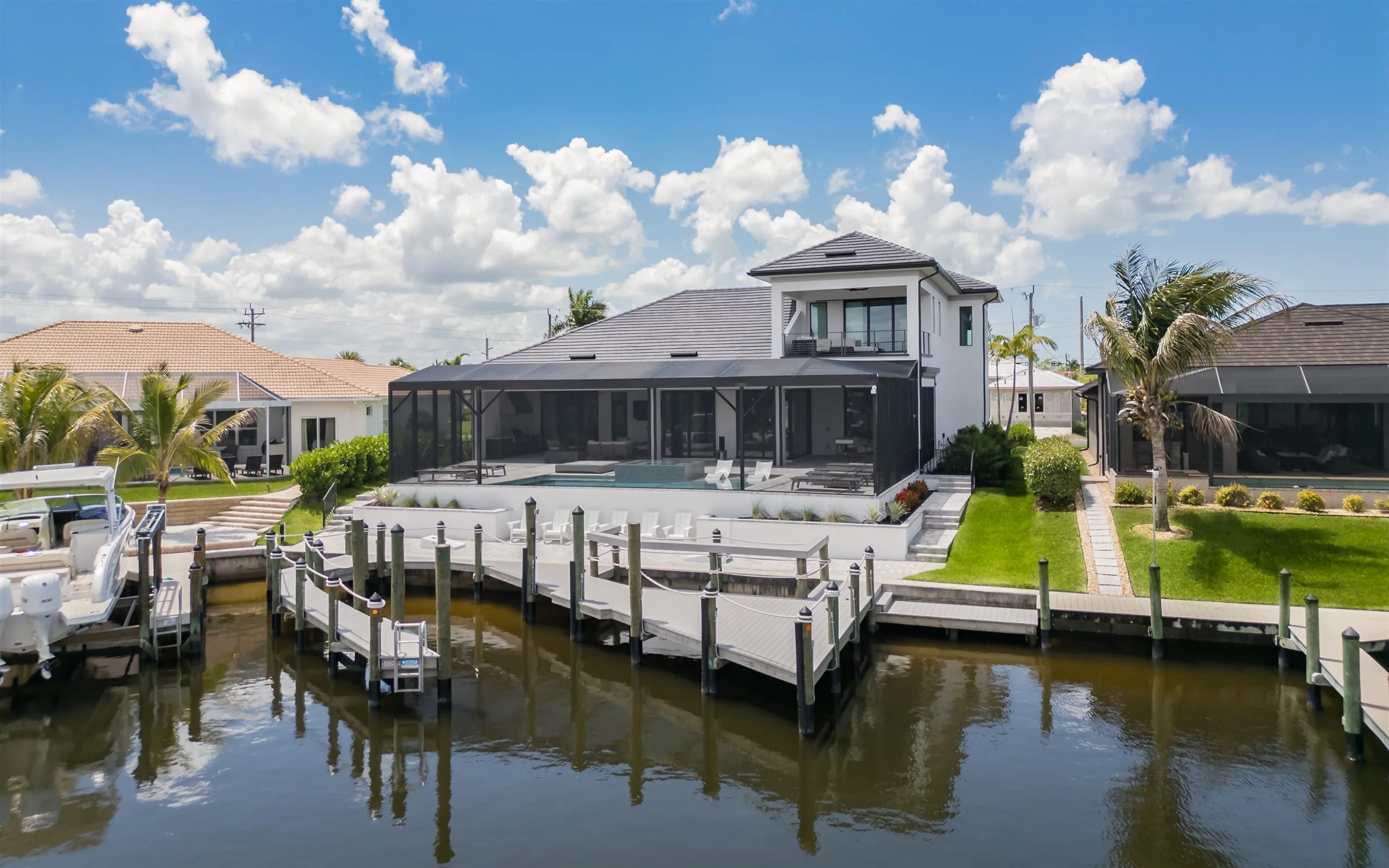
Cape Coral is not simply a Florida city located near the water. It was built around it.
The city has more than 400 miles of canals, many of which connect with the Caloosahatchee River and the surrounding Gulf waters. That extraordinary network gives residents and visitors the ability to begin a day of boating from a neighborhood canal, cruise into the river and continue toward beaches, islands, fishing grounds and waterfront restaurants throughout Southwest Florida.
For guests staying at Villa Sauvage, the waterfront is not an attraction that requires a drive. The home sits directly on a Gulf-access canal and includes a private dock, allowing approved boats and local charter operators to meet guests at the property.
That convenience can transform a Cape Coral vacation. But local waterways require preparation, particularly for boaters unfamiliar with canals, tides, shallow areas, posted speed zones and Southwest Florida weather.
This guide will help you understand the experience before leaving the dock.
Important: This article is a vacation-planning resource, not a navigation chart or substitute for local instruction. Routes, depths, bridge clearances, markers, tides and restrictions can change. Always use current nautical charts, a properly updated chartplotter and guidance from a qualified rental provider or licensed local captain.
Why Cape Coral Is One of Florida’s Great Boating Destinations
Cape Coral’s canal system places boating directly into the rhythm of everyday life.
Instead of storing a boat at a distant marina or launching it every morning, guests staying at the right Gulf-access vacation home can walk outside, load the cooler and depart from a private dock.
A boating day might include:
- Cruising the Caloosahatchee River
- Visiting Fort Myers Beach
- Exploring Sanibel or Captiva
- Shelling near an outer island
- Watching dolphins or manatees
- Fishing protected inshore waters
- Docking for lunch at a waterfront restaurant
- Returning home for sunset beside the pool
That flexibility is the real attraction. A short cruise does not need to become an all-day production, while experienced boaters can use Cape Coral as a base for considerably longer excursions.
Understanding Cape Coral’s Canal System
The word waterfront does not automatically mean Gulf access.
Cape Coral contains both freshwater and saltwater canal systems. Freshwater canals provide attractive views, kayaking and fishing opportunities, but they do not all connect to the Caloosahatchee River or open coastal waters. Gulf-access canals form part of a navigable saltwater system leading toward the river and beyond.
The City of Cape Coral publishes a freshwater and saltwater canal map, but the map itself warns that it is not intended for navigation, engineering or precise measurements. It should be used to understand the general canal system, not to plot a boating route.
Even among Gulf-access properties, routes vary considerably. Important considerations can include:
- Distance through residential canals
- Idle-speed and slow-speed zones
- Bridge clearance
- Vessel height
- Draft and water depth
- Canal width
- Tide level
- The location of the home within the canal system
- The condition and placement of navigation markers
For that reason, “Gulf access” should never be interpreted as a universal travel time or a guarantee that every vessel is appropriate for every property.
A Current Note About the Former Chiquita Lock
The City completed its Chiquita Lock removal and seawall-restoration project in June 2025. Boaters using that portion of the South Spreader Waterway no longer transit the former lock, although other route, depth, bridge and speed-zone considerations still apply. Not every Gulf-access property uses this route.
Boating From Villa Sauvage
Villa Sauvage includes a substantial private dock that can accommodate an approved boat up to approximately 40 feet long with a 12-foot beam.
Advance approval is required before bringing a personal boat or arranging a rental delivery. Guests should provide:
- Overall vessel length
- Beam
- Draft
- Height above the waterline
- Make and model
- Rental provider, when applicable
- Requested docking dates
These details allow the hosts to confirm that the vessel is appropriate for the dock and surrounding route.
Guests unfamiliar with the area should make their first departure and return during daylight. Residential canals can look very different after dark, and identifying turns, markers and dock locations becomes more difficult once the sun goes down.
The best approach is to save the route on the chartplotter during the first outing rather than trusting memory, or hoping that every waterfront house looks distinctive after sunset. Spoiler alert: after dark, Florida docks begin dressing alike.
Should You Bring a Boat, Rent One or Hire a Captain?
There are three practical ways to experience boating during a Cape Coral vacation.
1. Bring Your Own Boat
Experienced boat owners may prefer to bring a familiar vessel and keep it at Villa Sauvage throughout their stay.
Before traveling, confirm:
- Dock approval and vessel dimensions
- Trailer parking arrangements
- Local launch options
- Insurance coverage in Florida waters
- Available fuel range
- Tow coverage
- Required safety equipment
- Draft and bridge-clearance suitability
- Whether your navigation system contains current local chart data
Cape Coral currently identifies four principal improved boat ramps: Burnt Store, Horton Park, Rosen Park and the freshwater-only BMX ramp. The ramps are generally accessible 24 hours a day unless closed for repairs or safety reasons. Improved ramps presently require a $15 daily trailer-parking fee, paid before launching.
The appropriate ramp depends on the vessel, launch conditions and desired route. Do not select a ramp merely because it appears geographically closest on a road map.
2. Rent a Boat
A boat rental can give experienced visitors the freedom to explore independently without towing or launching their own vessel.
Before reserving, ask the rental company:
- Whether delivery to Villa Sauvage is available
- Whether pickup is available at the end of the rental
- Whether the boat has GPS and current local charts
- Whether saved routes or orientation are provided
- Which destinations are permitted
- Whether offshore travel is restricted
- What insurance and damage protection are included
- Whether towing coverage is provided
- Who pays for fuel
- What experience requirements apply
- How weather cancellations are handled
- Whether child-sized life jackets are available
One established local option, Cape Coral Boat Rentals at Cape Harbour, currently advertises GPS-equipped boats, saved tracks to popular destinations, safety equipment, navigation instruction and dock delivery for qualifying multi-day rentals. Terms and delivery availability should be confirmed directly when reserving.
A multi-day rental can make particularly good sense at Villa Sauvage. Instead of returning the boat after one outing, guests may be able to keep it at the private dock and use it for shorter cruises throughout the stay.
3. Book a Captained Charter
A private charter is often the best choice for guests who want the experience without taking responsibility for navigation.
A licensed local captain can:
- Plan an itinerary around current conditions
- Navigate unfamiliar canal and river routes
- Monitor tides and weather
- Select appropriate island and beach-access points
- Handle docking
- Adjust the trip when conditions change
- Allow the entire group to relax
This is particularly valuable for longer island trips or groups whose boating experience comes primarily from inland lakes.
Coastal Friends Boat Tours, for example, operates from Cape Coral and offers private outings to Fort Myers Beach, Sanibel, Captiva, North Captiva and Cayo Costa. The company also advertises pickup directly from waterfront vacation rentals in many areas.
Villa Sauvage does not need to include a boat for guests to enjoy doorstep service. With advance coordination, an approved charter may be able to collect the group directly from the villa’s dock.
Best Boating Destinations From Cape Coral
Actual travel times depend on the starting canal, vessel, route, tides, speed restrictions, weather and traffic. For that reason, this guide intentionally avoids promising exact journey times.
The Caloosahatchee River
The Caloosahatchee is the gateway between many Cape Coral canals and the surrounding coastal waters.
A local river cruise is an excellent first outing for visitors who want to become familiar with the area before committing to an island trip. The river offers broad views, passing boats, waterfront homes and access to multiple restaurants and marinas.
It can also be the perfect setting for a sunset cruise. Guests can enjoy time on the river and return to Villa Sauvage without building an entire day around a distant destination.
The river is a working and recreational waterway. Operators should remain attentive to channel traffic, wakes, speed zones and larger vessels.
Cape Coral Dock-and-Dine Restaurants
One of the pleasures of boating in Cape Coral is arriving at lunch or dinner by water.
Rumrunners
Rumrunners is located at Cape Harbour Marina and offers free docking for restaurant guests. Its waterfront location, marina setting and broad menu make it one of the city’s classic dock-and-dine choices.
Fathoms Restaurant & Bar
Fathoms is also located at Cape Harbour. It currently offers complimentary dockage while dining, can accommodate boats up to 50 feet through the marina and has fuel service available at Cape Harbour Marina. Boaters should contact the marina in advance regarding availability.
Bimini Basin Seafood & Cocktails
Bimini Basin’s official boating instructions direct guests north from the Caloosahatchee between channel markers 85 and 86 into Bimini Channel. The restaurant currently provides 42 dock-and-dine slips.
Slipaway Food Truck Park & Marina
Slipaway sits directly on the Caloosahatchee River near the Cape Coral Bridge. It combines ten food trucks, a central bar, live entertainment, a fuel dock and 30 public boat slips.
Dockage rules, availability and marina hours can change. Contact the destination before departure, especially on weekends, holidays and event days.
For more dining recommendations, link this section to:
The Best Restaurants Near Villa Sauvage in Cape Coral
Fort Myers Beach
Fort Myers Beach is a popular boating destination for waterfront dining, marina access and cruising around Estero Island.
The area includes hourly and transient dockage, fuel, restaurants and several marinas. Current construction, channel conditions and marina availability should be confirmed before departure, particularly because waterfront infrastructure has continued to evolve in recent years.
Boaters should not assume that every stretch of beach is appropriate for anchoring, beaching or passenger access. Use authorized locations, observe local markers and confirm current rules.
Sanibel and Captiva
Sanibel and Captiva are among Southwest Florida’s most recognizable boating destinations.
Depending on the day’s itinerary, visitors may cruise along the islands, stop for waterfront dining, look for dolphins, arrange shelling access or continue north toward Pine Island Sound and the outer islands.
Local tourism authorities regularly feature Sanibel, Captiva, North Captiva, Cabbage Key, Cayo Costa and Boca Grande as boating and charter destinations.
The waters surrounding the islands include shallow areas, marked channels, seagrass beds and tidal influences. Guests without local navigation experience should strongly consider a captain for their first island outing.
North Captiva and Cayo Costa
North Captiva and Cayo Costa offer a more remote experience than the developed waterfront areas closer to Cape Coral.
Cayo Costa State Park is accessible by water and offers miles of beach, shelling and natural surroundings. At the time of this July 2026 update, boaters may visit the park for day use from 8 a.m. until sunset. Ferry services and overnight accommodations remain unavailable, and park services can change, so the official park status should be checked before departure.
A trip to these outer islands requires more planning than a river cruise. Fuel range, weather, tides, anchoring conditions, passenger comfort and the rental company’s permitted operating area all matter.
Cabbage Key
Cabbage Key is a classic Old Florida boating destination accessible only by water.
The island’s inn, restaurant and bar welcome boaters for breakfast, lunch or dinner. The experience combines a boat trip, island setting and waterfront meal into one memorable outing.
Cabbage Key pairs naturally with a Pine Island Sound cruise or a visit near Cayo Costa, provided the day’s weather and boating conditions are appropriate.
Boca Grande and the Outer Islands
Boca Grande is better suited to an experienced operator, a capable vessel and a full-day itinerary.
The route can include Pine Island Sound, outer-island scenery and more exposed waters. Rental-company restrictions and fuel range should be verified before planning the trip.
For first-time Southwest Florida boaters, this is one of the trips where hiring a captain can substantially improve the day.
What Boaters Need to Know Before Leaving the Dock
Florida Boater-Education Requirements
Anyone born on or after January 1, 1988, who operates a motorboat of 10 horsepower or more in Florida must meet the state’s boating-education requirement and carry the appropriate identification. Florida also offers an approved temporary certificate for visitors, valid for up to 90 days after completion.
Rental companies may impose additional minimum-age, experience and qualification requirements beyond state law.
Life Jackets and Required Equipment
Every vessel must carry a properly sized, readily accessible, U.S. Coast Guard-approved wearable life jacket for each person onboard.
Vessels 16 feet or longer must also carry an immediately available throwable flotation device. A child under six must wear an approved life jacket while underway on a vessel under 26 feet. Additional requirements apply to distress signals, navigation lights, sound-producing devices and fire extinguishers.
Confirm children’s weights with the rental provider before arrival. “We have children’s life jackets” is not enough if the available sizes do not fit the children actually boarding.
Idle-Speed and Slow-Speed Zones
Florida distinguishes between two commonly encountered speed restrictions:
- Idle Speed-No Wake: Operate only fast enough to maintain steerage and forward movement.
- Slow Speed-Minimum Wake: The vessel must remain fully off plane and settled in the water without creating an excessive or hazardous wake.
Operators must follow the signs posted on the water rather than assuming one speed applies throughout the trip.
Residential canals should always be navigated carefully. Even where a specific restriction is not immediately visible, a large wake can damage docks, boats and seawalls.
Manatee Protection
Manatee-protection rules restrict vessel speed and, in some locations, vessel activity to reduce the danger of collisions and harassment.
FWC maintains protection-zone maps, but local and federal restrictions may also apply. Posted waterway signs govern the operator’s actions on the water.
Watch for circular “footprints” or swirls at the surface, a nose breaking the water and areas where manatees may be feeding. Reduce speed and give wildlife substantial space.
Shallow Water and Seagrass
Southwest Florida includes environmentally sensitive seagrass areas.
FWC advises boaters unfamiliar with a waterway to remain in marked channels and avoid shortcuts through seagrass beds. Propeller damage can fragment the habitat, take months or years to recover and expose the operator to legal and restoration consequences.
When a vessel begins losing depth, the answer is not to add throttle and “power through.” Stop, assess the situation and retreat carefully along the known route.
Navigation Markers and Charts
The traditional U.S. rule “Red, Right, Returning” means red lateral markers are generally kept on the vessel’s starboard side when returning from seaward.
That phrase is useful, but it is not a substitute for understanding the route. The Coast Guard notes that navigation aids can move and should not be the operator’s only means of determining position. A current nautical chart and chartplotter are essential.
Save the route from the dock during daylight and maintain situational awareness rather than blindly following an old electronic track.
Tides and Water Depth
Tide level can affect canal depth, shallow approaches, sandbars and beach access.
NOAA publishes tide predictions for stations throughout the area, including the Cape Coral Bridge and Fort Myers. Select the station closest to the intended route rather than relying on a generic “Cape Coral tide” result.
A route that felt comfortable at high tide may present a very different depth several hours later.
Weather and Thunderstorms
Southwest Florida’s rainy season generally runs from May 15 through October 15 and is characterized by frequent showers, thunderstorms and lightning. July through early September is typically the peak rainy-season period.
Before departure, check the National Weather Service marine forecasts for:
- Coastal waters from Bonita Beach to Englewood
- Charlotte Harbor and Pine Island Sound
- The Caloosahatchee and nearby inland waters
Thunderstorms can produce rapidly changing winds, reduced visibility, lightning and locally higher waves. The marine forecast repeatedly warns that winds and seas can be higher in and near thunderstorms.
During summer, an early departure often provides more flexibility before afternoon weather develops, but the forecast and radar, not the clock, should determine the plan.
A Practical Cape Coral Boating Checklist
Before leaving Villa Sauvage, confirm:
- The vessel is approved for the dock
- Fuel is sufficient for the route and reserve
- Weather and marine forecasts have been checked
- Tide conditions have been reviewed
- The chartplotter and local charts are current
- The return route to the villa is saved
- Every passenger has a correctly sized life jacket
- Required safety equipment is onboard
- A charged phone and VHF radio are available
- The group has water, sun protection and rain protection
- Someone ashore knows the itinerary and expected return time
- Dockage has been confirmed at the intended destination
- The operator is sober and prepared to remain attentive
The Coast Guard’s boating app includes safety checklists, float-plan tools, navigation information and emergency-contact features that may be useful when preparing for the day.
Sample Cape Coral Boating Itineraries
Relaxed Half-Day Outing
Begin with a daylight cruise through the canal system, enter the Caloosahatchee, enjoy the river views and stop at Bimini Basin or Slipaway for lunch.
This works well for a group that wants a boating experience without spending the entire day away from Villa Sauvage.
Cape Harbour and Waterfront Dining Day
Cruise toward Cape Harbour, arrange dockage and enjoy lunch at Rumrunners or Fathoms. Walk around the marina before returning to the villa for the pool and spa.
This combines boating, waterfront dining and an easy afternoon at home.
Fort Myers Beach or Sanibel Day
Plan a longer excursion toward Fort Myers Beach or the waters around Sanibel.
Confirm weather, fuel, dockage and the rental provider’s operating limits before departure. Guests unfamiliar with local channels should use a captain.
Outer-Island Adventure
Build a full-day itinerary around Captiva, North Captiva, Cayo Costa or Cabbage Key.
This is the most memorable option for many visitors, but it also requires the most experience and planning. A private charter is the best choice for guests who want to enjoy the islands without managing the route.
Experience Cape Coral From the Water at Villa Sauvage
Villa Sauvage was designed to connect the home with the Cape Coral waterfront lifestyle.
The private dock, Gulf-access canal, guest kayaks, expansive outdoor living area, heated pool and spa allow the water to become part of every day.
Guests can begin the morning with coffee overlooking the canal, meet a private captain at the dock, spend the day exploring Southwest Florida and return home for dinner beside the illuminated pool.
For approved guests bringing or renting a vessel, the dock can accommodate a boat measuring up to approximately 40 feet long with a 12-foot beam.
The best Cape Coral vacations are not merely spent near the water.
They begin there.
Plan Your Waterfront Stay
Explore Villa Sauvage, review the amenities and contact us before booking if you plan to bring or rent a boat.
Explore Villa SauvageCheck AvailabilityAsk About Boat Docking
Plan Your Stay at Villa Sauvage
Villa Sauvage is a five-bedroom Gulf-access home on a Cape Coral canal, with a heated pool and spa, a private dock and kayaks for guests. Explore the villa or check availability for your dates.